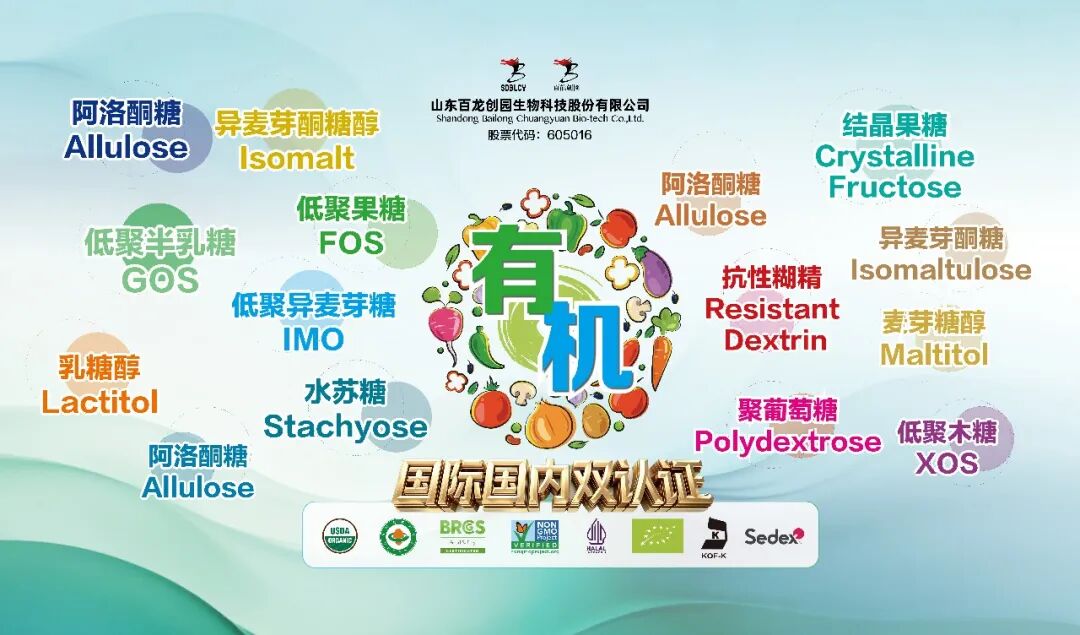
Resistant dextrin is derived from starch through industrial processing. It is a low-calorie glucan produced by extracting and refining the indigestible components of roasted dextrin, and belongs to the category of low-molecular-weight water-soluble dietary fiber. [Other products including Polydextrose, FOS, GOS, XOS, and so on.]
As a low-calorie, soluble food ingredient, resistant dextrin holds broad development prospects in the food industry. In recent years, driven by rising consumer demand for healthier diets, the global resistant dextrin market has been steadily expanding. Data shows that in 2021, the global resistant dextrin market size reached RMB 2.407 billion, representing a year-on-year increase of 8.37%; in 2022, the market size was approximately RMB 2.611 billion, up 8.48% from the previous year.
II. Resistant Dextrin Has Broad Application Prospects in Food, with Health Products as the Largest Application Market
Resistant dextrin is used across a wide range of food applications, including dairy products, infant food, health products, flour-based products, and meat products. Among these, health products represent the largest application segment, accounting for 38.7% of the market, followed by functional beverages (18%) and dairy products (17%). Flour-based products and infant food account for 15% and 13%, respectively.
Downstream Applications of Resistant Dextrin by Sector
In dairy products, resistant dextrin can be added as simply as sugar or saccharides without affecting the original flavor of food, making it suitable for fiber-fortified dairy products or fiber-supplemented milk beverages. Its similar mouthfeel to fat and low calorie content also make it an ideal low-calorie maltodextrin for dairy applications—for example, replacing part of the sugar or fat in low-calorie ice cream or low-fat yogurt drinks. As fermented milk and lactic acid beverage consumption increases, adding resistant dextrin enhances its synergistic effects with beneficial gut bacteria such as lactic acid bacteria and bifidobacteria.
In infant food, infants especially after weaning experience a sharp decline in bifidobacteria, which can lead to diarrhea, anorexia, developmental delays, and reduced nutrient utilization. Consumption of water-soluble resistant dextrin can improve nutrient absorption and promote the utilization of trace elements such as calcium, iron, and zinc.
In flour-based products such as bread, steamed buns, rice, and noodles, adding dietary fiber can improve crust color. At 3%–6% of flour weight, dietary fiber strengthens dough gluten; steamed buns have a good taste and distinctive aroma; cooked noodles show increased firmness and better boiling resistance. Since biscuits and pastries contain higher sugar and oil with lower moisture, dietary fiber addition is particularly beneficial. Biscuit baking requires low gluten strength, allowing for high proportions of resistant dextrin to produce functional health biscuits. In pastries, water-soluble resistant dextrin helps maintain softness and moisture, extending shelf life.
In meat products, dietary fiber and protein interact via salt and hydrophobic bonds to form thermally stable gels. The complex formed by soluble dietary fiber and protein is a novel gel system. Additionally, dietary fiber adsorbs flavor compounds, preventing volatile loss. Adding dietary fiber improves product yield, texture, and quality. As a superior fat substitute, water-soluble dietary fiber enables the production of high-protein, high-fiber, low-fat, low-salt, low-calorie functional hams and sausages.
III. Global Resistant Dextrin Production Capacity Is Relatively Concentrated
Growing demand for resistant dextrin has driven output growth, and global production capacity remains relatively concentrated. Regionally, North America, Europe, China, and Japan together account for nearly 80% of total capacity, with shares of 25.4%, 19.36%, 17.87%, and 16.57%, respectively. India and Southeast Asia hold smaller shares at 6.64% and 7.09%, respectively.
(Data source: China Insights Industry Consulting data center)
At the company level, the number of global resistant dextrin manufacturers is limited. Key players include Baolongchuangyuan (China), Tate & Lyle (UK), Matsutani Chemical (Japan), Roquette (France), and ADM (US). The top three companies hold a combined market share (CR3) of 36%. Among them, Baolongchuangyuan is China's leading producer, contributing the vast majority of domestic output and accounting for 12% of global resistant dextrin production capacity.